
Dougherty County Court Records After Arrest
After a Dougherty County jail arrest, the jail record and the court record develop on different tracks. The jail booking record starts with intake, custody, charge entry, bond fields, and public roster data. The court record begins when the charge moves into Magistrate Court, State Court, Superior Court, Albany Municipal Court, or the prosecutor's filing process. That distinction matters because the booking charge listed in the jail roster may not match the final charge filed by the prosecutor.
For custody status, bond clues, and booking charges, use Dougherty County jail inmate records. For booking-photo rules and the current non-mugshot roster finding, use Dougherty County jail mugshots. Court records after a jail arrest focus on the case: complaint or warrant basis, accusation, indictment, docket activity, charge status, bond orders, disposition, and record-restriction results.
Search Dougherty County Court Records
The official Dougherty County Clerk of Court page identifies Phyllis N. Johnson as Clerk of Dougherty Superior Court and points users to the civil and criminal case-search portal. The clerk's office is at 225 Pine Avenue, Suite 126, Albany, GA 31701, with phone 229-431-2198, email dococlerks@dougherty.ga.us, and hours Monday-Friday, 8:30 a.m.-5:00 p.m. The county page says to call the clerk during business hours if users have trouble navigating the system.
The research inspection found that the Tyler Court Case Management portal opens to a login screen. It showed User Name and Password fields, both marked with an asterisk, plus Forgot Password, Tyler Technologies, and Tyler Privacy Notice links. No public guest search, defendant-name field, case-number field, payment field, or document-download field was visible before login. That is a real access limit, so court records after a jail arrest may require clerk contact even when an online portal exists.
| Field Label | Type | Required | Format Notes |
|---|---|---|---|
| User Name | Text | Yes | Marked with an asterisk; no public format guidance visible. |
| Password | Password | Yes | Marked with an asterisk; no guest access visible before login. |
The research screenshot for the Clerk of Court source page shows the local contact details and case-search link used for Dougherty County court records after an arrest.
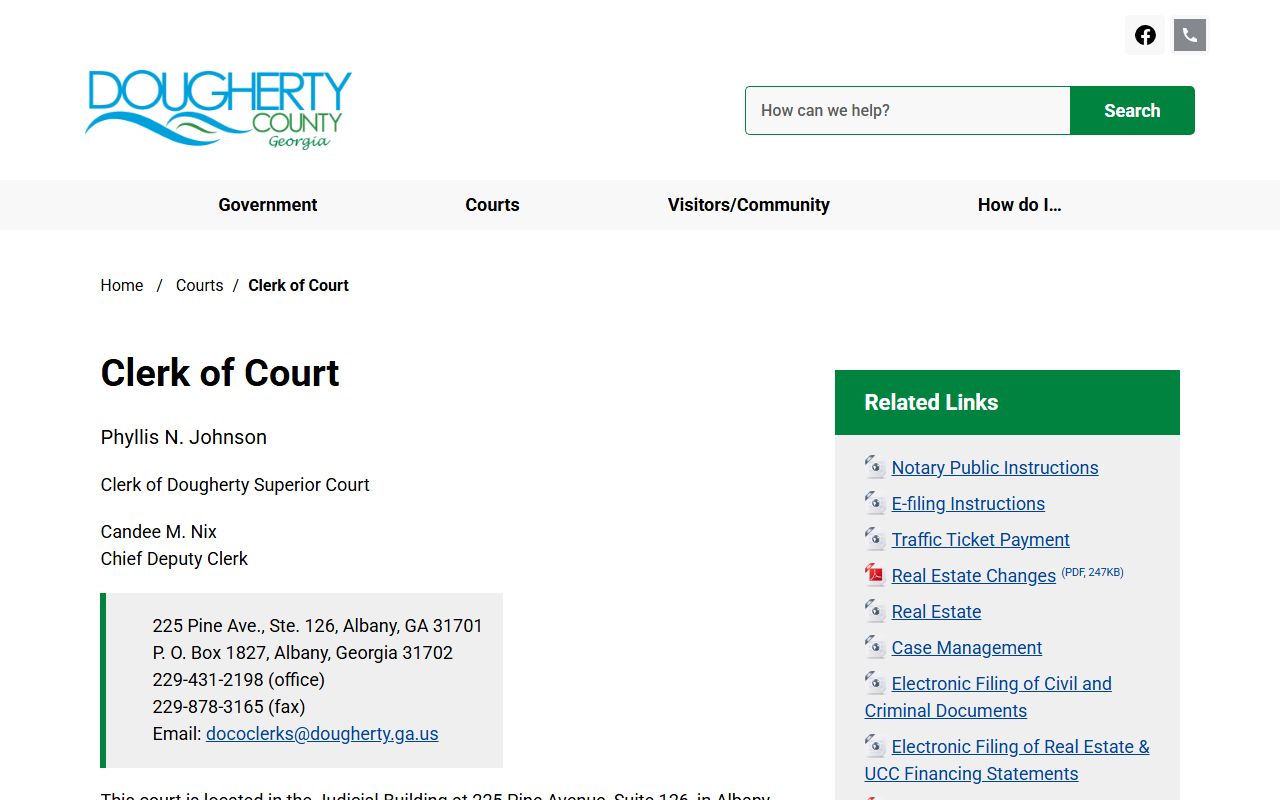
The clerk page is the official local bridge between the jail arrest and the court case-search path.
Dougherty County Arrest Court Path
The court path depends on the charge and the arresting agency. Magistrate Court issues warrants for all criminal offenses and holds committal hearings, which are early probable-cause hearings. Superior Court has exclusive jurisdiction over felony cases and handles hearings, trials, judgments, and sentencing. State Court handles misdemeanors punishable by 12 months or less. Albany Municipal Court handles city misdemeanor cases, ordinance enforcement, traffic, DUI, underage alcohol, marijuana under one ounce, firearms, nuisance, abatement, and animal-control citations.
- Check the jail roster or recent-arrests module for the booking charge and bond clues.
- Identify whether the matter looks like a felony, state misdemeanor, municipal case, warrant, probation issue, or failure to appear.
- Use the clerk case-search portal if access is available, or call the clerk when login access is unclear.
- For city cases, contact Albany Municipal Court or use the city's public-records request channel.
- For warrants or committal hearing questions, contact Magistrate Court or Sheriff Warrants/Civil.
- For formal prosecutor-filed charges, track the District Attorney's accusation or indictment process.
Albany Municipal Court adds a local timing point: in-custody arraignments are held at the Dougherty County Jail Facility at 7:30 a.m. on Monday, Wednesday, and Friday. Regular municipal arraignments and bench trials are held at the Albany Law Enforcement Center on Monday, Wednesday, Thursday, and Friday beginning at 9:00 a.m. or immediately after jail arraignments.
Dougherty County Charging Documents
Formal charges after a jail arrest may come from several document types. Georgia and local Dougherty research most strongly supports complaint or warrant material at the Magistrate Court stage, plus accusations and indictments from the District Attorney's filing role. The District Attorney page says the office prepares indictments for the Grand Jury and accusations for filing to bring cases to trial. That is the key local source for why a jail booking charge may later become a different court charge.
| Document | Who Uses or Files It | How It Fits After Arrest |
|---|---|---|
| Complaint or warrant | Officer, court, or prosecutor depending on the stage | Can be the initial accusation or legal basis that leads to arrest, booking, and a court appearance. |
| Accusation | District Attorney | Prosecutor-filed charging document used to bring some cases to trial without a grand-jury indictment. |
| Indictment | Grand Jury, prepared through the District Attorney process | Formal felony charging document used in Superior Court prosecution. |
Dougherty County Charge Status
Charge status tells where a court record stands after an arrest. A booking charge may be pending at first, then amended, reduced, dismissed, or resolved by plea, trial, nolle prosequi, dead docket, acquittal, or conviction. A nolle prosequi, often shortened to nol pros, means the prosecutor declines or abandons prosecution of a charge. A disposition is the final result of a charge. These terms should be read from the court record, not inferred from the jail roster alone.
| Status | Meaning in a Court Record | Why It Matters |
|---|---|---|
| Pending | The case or charge has not reached a final result. | Bond, court dates, and charge wording may still change. |
| Amended or reduced | The filed charge changed after prosecutor or court review. | The final court charge can differ from the jail booking charge. |
| Dismissed | The charge ended without a conviction by court or prosecutor action. | Dismissal may support later record-restriction review if eligible. |
| Nolle prosequi | The prosecutor declined or abandoned that charge. | It is not the same as a guilty plea or conviction. |
| Disposition | The final outcome, such as plea, conviction, acquittal, dismissal, dead docket, or nol pros. | This is the result field to look for when evaluating the case history. |
Bond After Dougherty County Arrest
Bond after a Dougherty County arrest begins with the jail and court process, often at first appearance or through the court with jurisdiction over the charge. The public jail roster includes total bond amount and per-charge bond fields, but the research warns that those fields should not be treated as final court orders. Sample rows showed state-bond entries, active and inactive abbreviations, zero-dollar rows, and docket numbers. A person may still be held because of probation, failure to appear, another jurisdiction, a detainer, or a no-bond hold.
Cash-type bond: Money is paid under court or jail rules to secure release, but Dougherty County Jail or Jail Intake should confirm the amount first.
Surety bond: A bonding company or surety backs the release amount, and all charge rows or holds should be checked before use.
Recognizance or personal bond: Release is based on conditions rather than full cash payment, so online jail fields may not show the full order.
No-bond hold or detainer: Money may not release the person because a warrant, probation, state, federal, or ICE hold exists.
Dougherty County Warrants and Arrest Records
Dougherty County Magistrate Court is the key warrant source in the research. The official page says Magistrate Court issues warrants for all criminal offenses and holds committal hearings. Sheriff Warrants/Civil can be reached at 229-302-3605, Magistrate Court at 229-431-3216, the main sheriff number at 229-302-3600, and Jail Intake at 229-430-6531. The P2C navigation showed Wanted Persons and Most Wanted routes, but direct endpoint inspection found the wanted-persons module was not enabled, so no public active warrant list should be assumed from P2C.
The Dougherty County Magistrate Court page is the official local source for warrant and committal-hearing jurisdiction.
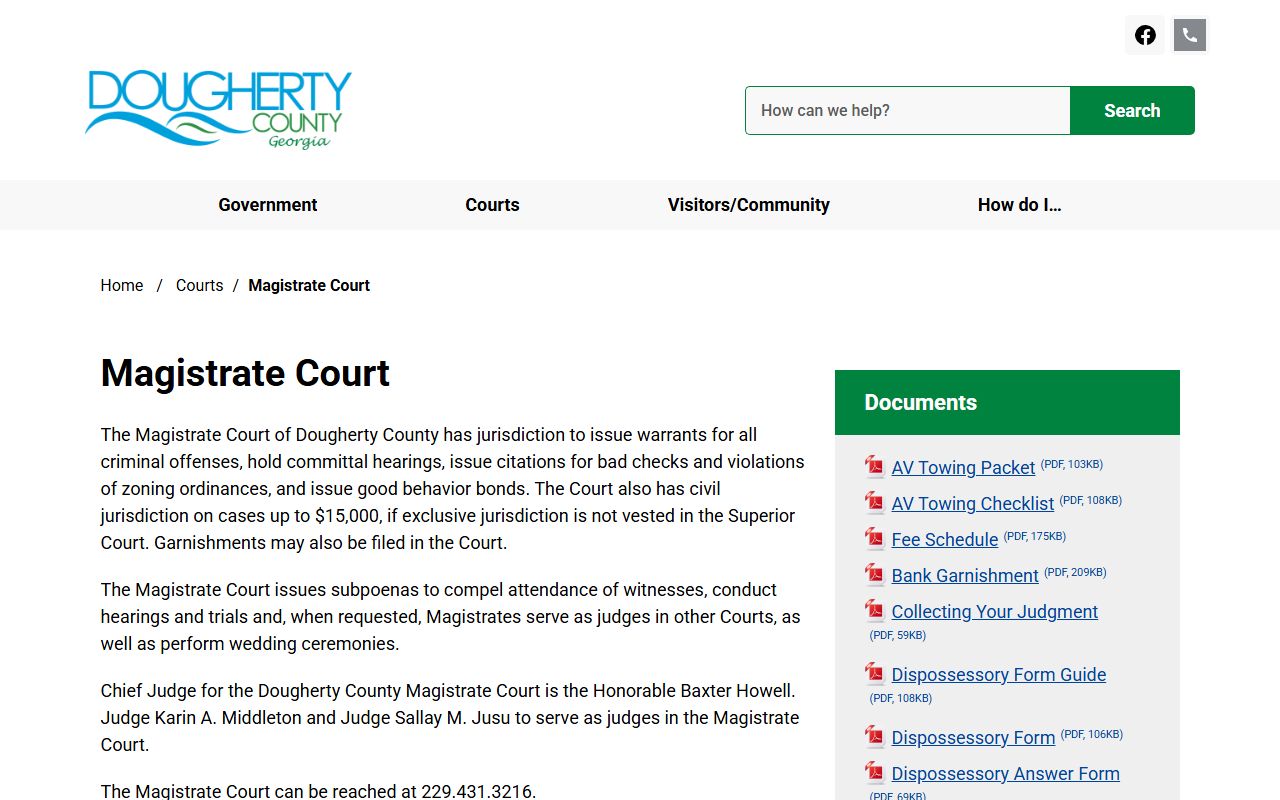
That court role is why a warrant arrest may create both a jail booking record and later court records after the arrest.
Charges vs Convictions
A charge is an accusation. A conviction is a court result after a guilty plea, guilty verdict, or other conviction outcome. Court records after a jail arrest may show charges long before the case reaches a final disposition. The presence of a charge, warrant, bond amount, or jail booking does not mean the person was convicted.
Charge: An accusation after arrest, warrant, complaint, accusation, or indictment. It may rest on probable cause or prosecutor filing and can appear while the case is pending.
Conviction: A final court outcome based on plea, verdict, or judgment. It can affect sentence, custody, probation, parole, and criminal history.
Lookup caution: Do not treat a booking charge as guilt. Read the disposition and sentence fields before drawing conclusions.
Dougherty County Record Restriction
Georgia's public-facing term is record restriction, not a blanket promise of expungement. Georgia.gov record restriction guidance says eligible records may be hidden or sealed from public view. The Georgia Courts record-restriction materials explain that GCIC usually processes complete applications in two to three weeks. O.C.G.A. § 35-3-37 is the main state statute for restricting eligible criminal history records from public non-criminal-justice disclosure.
Restricted: Eligible criminal history is limited from public non-criminal-justice disclosure, though law enforcement and criminal-justice users may still have access under law.
Sealed or hidden: Common public wording for records removed from public view after eligibility review, not proof that every outside copy is gone.
Expunged: Older or informal wording often used by the public. Georgia official sources now commonly use record restriction.
Georgia Open Records Act access also has exceptions. O.C.G.A. § 50-18-72 covers public-disclosure exceptions, including limits tied to pending law-enforcement or prosecution records. Initial arrest information and later court records can be treated differently, so the originating office should explain any denial, redaction, or routing decision.
Dougherty County DA and Defense
The Dougherty County District Attorney is Gregory W. Edwards. The office is in the Judicial Building at 225 Pine Avenue, Suite 231, Albany, GA, and can be reached at 229-431-3233. The DA prosecutes criminal violations in the Dougherty Judicial Circuit, attends pretrial hearings, grand jury sessions, and trials in Superior, State, and Juvenile Courts, prepares indictments and accusations, handles appeals from past convictions, and protects victims of crime.
The Dougherty Circuit Public Defender is Troy Golden. The office email is publicdefender@dougherty.ga.us, the office is at 225 Pine Avenue, Suite 100, Albany, and the phone number is 229-483-6240. Public Defender contact may matter when a person is in custody, cannot afford counsel, and needs help with bond, first appearance, charge status, or later court dates.
Important: Court records after an arrest should be verified with the clerk, court, prosecutor, or defense counsel before use in any serious decision.